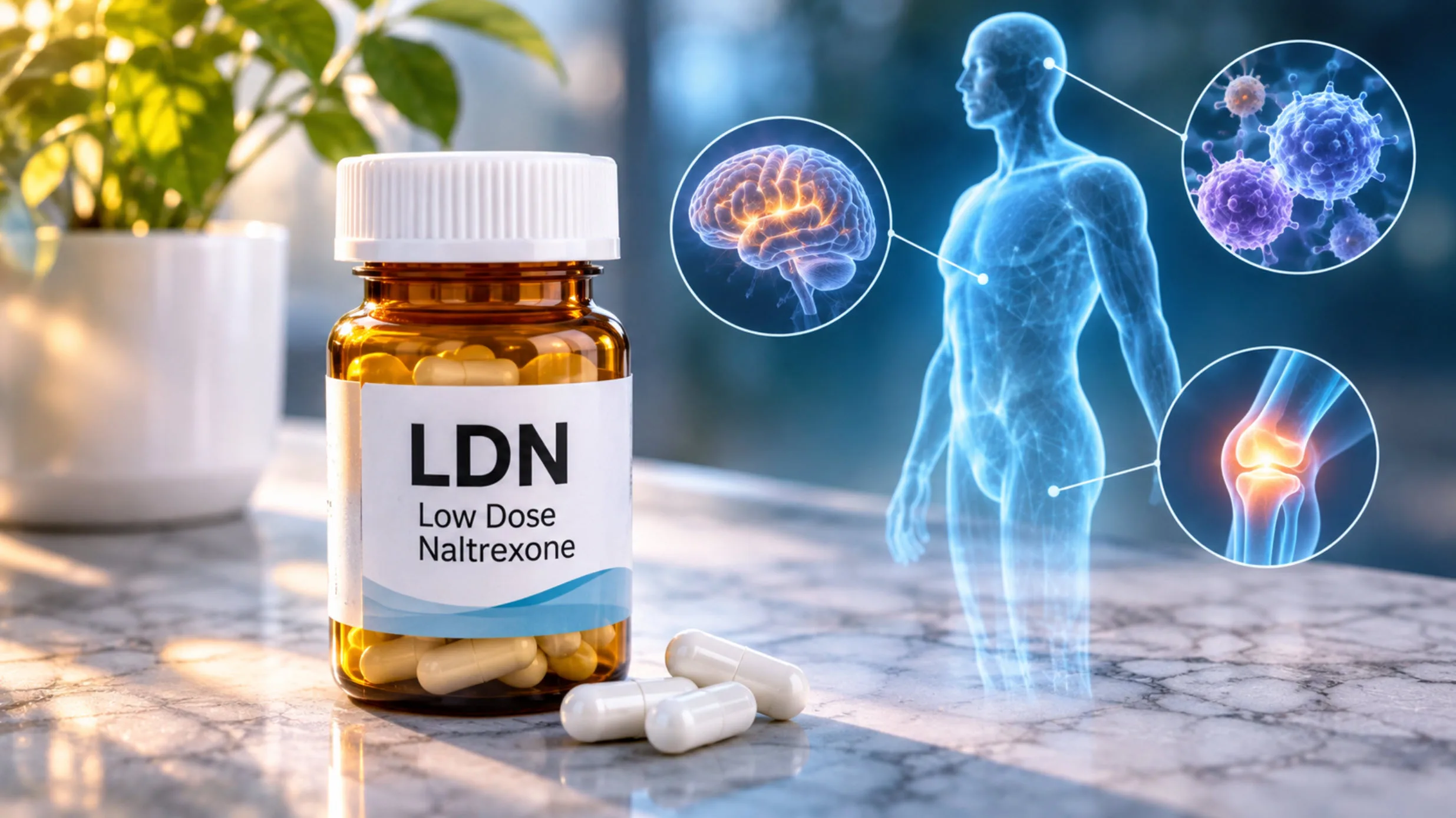
Healthy aging involves more than simply living longer. Researchers are increasingly focused on understanding how inflammation, immune regulation, cellular health, and other biological processes influence the quality of life as people age.
One medication attracting interest in this area is low dose naltrexone, commonly known as LDN.
Originally developed at higher doses to treat alcohol and opioid dependence, naltrexone is now being investigated at much smaller doses for its potential effects on inflammation, immune signaling, and certain chronic health conditions.
This growing interest has also introduced LDN into the broader longevity conversation, particularly as researchers examine the relationship between chronic inflammation and age-related changes in health.
Although early findings are encouraging in some areas, understanding what the research actually supports is important when considering LDN as part of a healthy aging strategy.
- LDN is being investigated for potential effects on inflammatory and immune signaling.
- Early research has explored its use in certain chronic pain and inflammatory conditions.
- Clinical evidence remains limited and sometimes inconsistent.
- LDN has not been proven to slow aging or extend human lifespan.
- Medical supervision is important, especially because of potential medication interactions.
What Is Low Dose Naltrexone?
LDN refers to the use of naltrexone at doses substantially lower than those traditionally prescribed for alcohol or opioid use disorders.
Standard oral naltrexone treatment commonly involves a 50 mg daily dose, while low dose naltrexone is often studied at approximately 1 to 4.5 mg daily. Dosing varies depending on the condition being investigated and the prescribing healthcare professional.
Naltrexone is an opioid receptor antagonist, meaning it blocks the activity of certain opioid receptors in the body.
At conventional doses, this action helps reduce the effects of opioids and supports treatment for substance use disorders.
At lower doses, researchers are exploring whether naltrexone may influence additional biological pathways, including immune signaling and inflammatory responses.
These potential effects have encouraged investigation into applications beyond the medication's original approved uses.
However, LDN is not an FDA-approved treatment for inflammation, healthy aging, or longevity.
Standard dose, approved use
Typically prescribed at around 50 mg daily for alcohol or opioid use disorders. This is the FDA-approved use of the medication.
Reduced dose, investigational use
Studied at approximately 1 to 4.5 mg daily for possible effects on inflammation and immune signaling. This is an off-label, investigational use, not an FDA-approved indication.
Why Is Inflammation Important in Healthy Aging?
Inflammation is a normal and essential part of the body's defense system.
When an injury or infection occurs, inflammatory responses help protect tissues and support healing.
Problems may develop when inflammatory activity becomes persistent or poorly regulated.
Chronic low-grade inflammation has been associated with several age-related conditions, including cardiovascular disease, metabolic disorders, and changes in physical function.
Researchers sometimes refer to this process as inflammaging, a term describing the relationship between aging and persistent inflammatory activity.
Inflammaging describes a pattern researchers have observed, not a diagnosis or a disease. A few points are worth keeping in mind: inflammation itself is a normal biological response the body needs in order to heal and defend itself. Persistent, low-grade inflammation over many years has been associated with certain age-related conditions, rather than being the direct cause of any single one. Researchers are still investigating how specific inflammatory pathways relate to healthy aging, and that research is ongoing rather than settled.
As people age, changes in immune function, cellular stress responses, and metabolic regulation may contribute to increased inflammatory signaling.
This relationship has encouraged scientists to investigate whether managing certain inflammatory pathways could support healthier aging.
LDN has attracted attention because preliminary research suggests it may influence some processes involved in immune and inflammatory regulation.
How Might LDN Influence Inflammation?
Researchers have proposed several mechanisms that could explain the potential anti-inflammatory effects of LDN.
One involves the medication's interaction with opioid receptors, which participate in pain signaling and other physiological processes.
Another proposed mechanism involves microglia, specialized immune cells located in the central nervous system.
Microglia help protect the brain and spinal cord, but excessive or prolonged activation may contribute to neuroinflammatory signaling.
Laboratory research suggests that naltrexone may influence certain inflammatory pathways associated with microglial activity.
Some studies have also investigated interactions involving toll-like receptor 4 (TLR4), a receptor involved in innate immune responses.
Opioid Receptor Interactions
Naltrexone blocks certain opioid receptors, which participate in pain and other signaling pathways throughout the body.
Microglial Activity
Proposed to influence the behavior of microglia, the immune cells of the central nervous system, which can otherwise drive neuroinflammatory signaling when overactive.
Inflammatory Signaling
Studied for a possible role in modulating broader inflammatory signaling pathways associated with chronic, low-grade inflammation.
TLR4 Related Mechanisms
Some research has examined interactions with toll-like receptor 4, a receptor involved in the body's innate immune response.
However, much of the evidence supporting these proposed mechanisms comes from laboratory or preclinical research.
It remains uncertain how consistently these effects occur in humans at commonly prescribed LDN doses.
What Does the Research Say About LDN and Chronic Pain?
One reason LDN has received increasing attention is its investigation in conditions involving persistent pain.
Researchers have evaluated LDN in fibromyalgia, a condition characterized by widespread pain, fatigue, sleep disturbances, and other symptoms.
Some small clinical studies have reported improvements in pain-related measurements among participants receiving LDN.
However, findings have not been consistent across studies, and larger randomized trials have challenged some of the earlier positive results.
- Encouraging signals: Some small studies, particularly in fibromyalgia, have reported improvements in pain-related measurements.
- Inconsistent results: Findings have not replicated consistently across different research groups and conditions.
- Larger trials raise questions: Bigger, more rigorous randomized trials have challenged some of the earlier positive findings.
- More research needed: The overall body of evidence is not yet large or consistent enough to establish LDN as a reliable chronic pain treatment.
Researchers have also explored LDN in other chronic pain conditions, although the quality and quantity of evidence vary considerably.
These findings suggest that LDN warrants continued investigation, but they do not establish it as an effective treatment for all forms of chronic pain.
Pain management should remain individualized and guided by the underlying condition, available evidence, and patient-specific risks.
LDN and Immune System Regulation
The immune system undergoes significant changes throughout life.
With aging, some immune responses become less effective, while certain inflammatory processes may become more active.
Researchers describe aspects of this gradual change as immunosenescence.
Because LDN has been investigated for possible effects on immune signaling, scientists have questioned whether it could influence certain immune-related conditions.
Small studies and observational reports have examined LDN in conditions such as Crohn's disease and multiple sclerosis.
Some findings have suggested potential improvements in selected symptoms or clinical measurements.
However, these studies are generally limited in size, and results have not established broad immune-regulating benefits.
There is currently insufficient evidence to conclude that LDN reverses immunosenescence, strengthens immune function, or prevents age-related disease.
Could LDN Have a Role in Longevity Research?
Longevity science increasingly examines biological pathways that influence multiple aspects of health rather than focusing exclusively on individual diseases.
Chronic inflammation is one of these areas because it is associated with several conditions that become more common with age.
LDN's proposed effects on inflammatory and immune signaling have therefore generated interest in its potential relevance to healthy aging.
However, there is an important distinction between investigating a biological mechanism and demonstrating that a medication improves long-term health outcomes.
No large clinical trials have established that LDN slows biological aging, extends human lifespan, or prevents age-related diseases in otherwise healthy individuals.
The connection between LDN and longevity remains a research hypothesis rather than a demonstrated clinical benefit.
Future studies may help determine whether particular populations or inflammatory conditions respond meaningfully to lower-dose naltrexone treatment.
What Are the Potential Side Effects and Risks?
Although LDN uses smaller doses than conventional naltrexone treatment, it can still cause adverse effects.
Reported side effects include vivid dreams, sleep disturbances, headaches, nausea, and gastrointestinal discomfort.
Some individuals may experience changes in sleep quality or temporary discomfort when beginning treatment.
An especially important consideration is the medication's interaction with opioids.
Because naltrexone blocks opioid receptors, it can interfere with opioid pain medications and may precipitate withdrawal in individuals who are physically dependent on opioids.
Naltrexone also requires caution in individuals with certain liver conditions.
Long-term safety information specifically involving LDN for healthy aging remains limited.
- Vivid dreams and sleep disturbances, especially when starting treatment
- Headaches, nausea, and general gastrointestinal discomfort
- Interference with opioid pain medications, since naltrexone blocks opioid receptors
- Possible precipitated withdrawal in individuals physically dependent on opioids
- Caution required in people with certain liver conditions
- Limited long-term safety data specifically for healthy aging applications
Individuals should discuss their medical history, current medications, and potential treatment risks with a qualified healthcare professional before beginning therapy.
Why Medical Oversight Matters With LDN
As interest in longevity-focused treatments increases, more individuals are exploring medications that have established uses in other areas of medicine.
However, off-label treatment should still involve appropriate medical evaluation and ongoing oversight.
For individuals researching low dose Naltrexone, AgelessRx provides information about its LDN treatment program and approach to clinician-guided care.
A healthcare professional can review existing conditions, medication use, potential contraindications, and treatment goals before determining whether LDN may be appropriate.
Monitoring is also important because treatment response can vary considerably.
Patients should understand that improvements reported in certain chronic conditions do not necessarily predict benefits for general wellness or longevity.
Explore Low Dose Naltrexone Through AgelessRx
For people interested in learning more about low dose naltrexone, AgelessRx provides information about its LDN treatment program and approach to clinician-guided care. A qualified healthcare professional can help evaluate medical history, medication interactions, and whether treatment may be appropriate.
Learn More at AgelessRxAdvertisement. AgelessRx is a third party telehealth provider. Your Health Radio does not independently verify commercial claims made on third party sites.
How LDN Fits Into a Broader Healthy Aging Strategy
Healthy aging depends on multiple interconnected factors, including metabolic health, physical activity, nutrition, sleep, and management of chronic medical conditions.
While researchers continue investigating medications that may influence age-related biological pathways, established lifestyle interventions remain important.
Regular exercise, maintaining muscle strength, consuming a balanced diet, and addressing cardiovascular risk factors all contribute to long-term health.
Physical Activity
Regular movement supports cardiovascular, metabolic, and musculoskeletal health over time.
Muscle Strength
Maintaining strength supports mobility, balance, and independence as people age.
Balanced Nutrition
Consistent, varied nutrition supports metabolic and overall health.
Sleep
Quality sleep supports immune function, metabolism, and recovery.
Cardiovascular Risk Management
Addressing blood pressure, cholesterol, and related factors supports long-term health.
Managing Chronic Conditions
Ongoing management of existing medical conditions remains foundational to healthy aging.
LDN should not be viewed as a replacement for these approaches.
Instead, its potential role should be considered within the context of specific medical conditions, individual treatment goals, and the evolving clinical evidence.
The Future of LDN and Healthy Aging
Interest in LDN reflects a broader movement toward understanding how immune signaling and chronic inflammation influence health over time.
Early research has identified possible applications in certain inflammatory and pain-related conditions, but important questions remain about effectiveness, appropriate dosing, and long-term safety.
Larger, well-designed clinical trials are needed to determine which patients may benefit and whether the proposed biological mechanisms produce meaningful health improvements.
For now, LDN remains an investigational approach for many of the conditions being studied.
Its potential relationship with longevity is scientifically interesting, but not yet clinically established.
As research advances, healthcare professionals and patients may gain a clearer understanding of whether LDN has a meaningful place in strategies designed to support healthier aging.
- Research into LDN and inflammation is ongoing, not settled.
- Evidence for a longevity benefit remains insufficient to draw firm conclusions.
- Individual medical circumstances, including other conditions and medications, matter a great deal.
- Treatment decisions require a qualified clinician's evaluation, not self-directed experimentation.
- Larger, independent clinical trials are needed before stronger claims can be made.
Continue the Conversation on Medications and Healthy Aging
LDN is one of several medications being studied in connection with inflammation and healthy aging. Visit the Medications hub for more educational coverage, or subscribe to hear about new topics as they are published.